
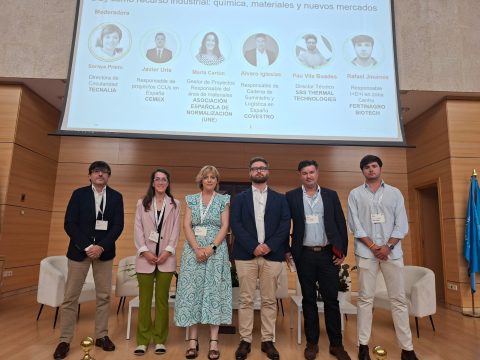
“More than 80 specialists attended the first edition of CO2 Economics in Madrid, co-organised by TECNALIA and itdUPM”
TECNALIA views the CO2 economy as a key factor for industrial competitiveness, energy security and the development of new markets
CO₂ is no longer solely an environmental issue. It has become a strategic vector for industrial competitiveness, energy security and the development of new markets. The presentations by Sergio Domínguez, Head of the UPM Higher Technical School of Industrial Engineering and Mariano Marzo, together with the discussions at the three round tables, highlighted a shared view: CO₂ is no longer merely an emission to be managed, but a raw material with the potential to create value.
- The debate on CO₂ has evolved rapidly, shifting from a focus on reducing emissions to looking at transport infrastructure, geological storage, synthetic fuels, new materials, circular chemistry, certification and investment.
- CO₂ has evolved from being an environmental challenge to becoming a cornerstone of economic activity and the creation of emerging markets.
The speakers agreed that key technologies—carbon capture, storage, synthetic fuels and industrial uses of CO₂—are already in operation. The challenge is not their viability, but how to roll them out at the scale and speed required, which needs infrastructure, logistics hubs, sustainable sources of carbon, and an integrated value chain that links emitters, processors and end users.
The key factors for CO₂: speed, competitiveness and trust
“The debate is no longer about whether CO₂ can be part of the solution, but about how to create the conditions required for that solutionto be rolled out on an industrial scale, in a competitive manner, so that it makes a real impact”.
- The window of opportunity is limited. While the United States, Asia and Northern Europe are moving forward with clear national strategies, Spain has the industrial, technological and scientific capabilities to play a significant role, but it needs to act more swiftly and adopt a national approach.
- The need to ensure competitiveness: the transition will only be possible if there are viable business models, stable regulatory frameworks and mechanisms to reduce the risks associated with initial investments.
- A key factor in the development of new markets is trust, based on traceability, certification and robust carbon accounting methodologies.
- Soraya Prieto, TECNALIA’s Head of Circularity, brought the meeting to a close with an optimistic outlook: Spain has the resources and talent to play a leading role in this new carbon economy.