
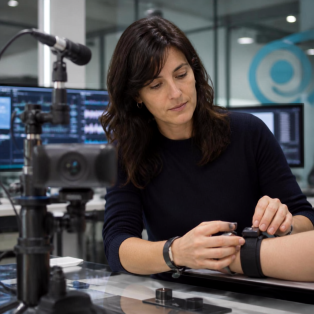
"Machine and human digital twins will be able to exchange information and participate in negotiation processes"
The industry of the future adapts to people thanks to human digital twins
The GIZAKITU initiative researches the development of human digital twins , a technology that will integrate information on the well-being of workers into industrial systems so that these can be more efficiently adapted to real operating conditions.
- The aim is to ensure that factories of the future are not only capable of monitoring machines and processes, but also of gaining a better understanding of the well-being of the people working in them.
- Therefore, work is being carried out on the capture and analysis of various human signals in order to estimate variables, such as level of attention, alertness, fatigue or workload in order to facilitate safer and more adaptive decision-making.
Machine and human digital twins for more efficient collaboration
One of the project’s main demonstrators will be developed jointly by the University of the Basque Country (EHU) and . TECNALIA: human monitoring capabilities will be integrated with the SMIA platform, an architecture designed to facilitate the interoperability and coordination of industrial assets.
- In this scenario, machine and human digital twins will be able to exchange information and participate in negotiation processes for the dynamic allocation of productive tasks.
- This use case will assess how the well-being of workers can be incorporated into the system’s decision-making process, facilitating the dynamic allocation of tasks based on variables, such as the level of attention, workload or the operational status of each individual.
- This represents a step towards industrial environments in which people, machines and production systems collaborate more intelligently and efficiently.
Monitoring attention and fatigue in human-robot collaboration
We are taking part in a second use case led by IKERLAN, which focuses on analysing the operator’s attention and fatigue levels while supervising and interacting with a collaborative robot.
- The research focuses on monitoring human well-being to foster safer and more efficient human-robot collaboration, validating the detection technologies developed within the project.
The HF&UX Laboratory contributes to the development of a people-centred industry
As part of this research, our Human Factors and User Experience Laboratory (HF&UX Lab) has carried out a study involving 40 participants.
Using microphones, cameras and physiological monitoring devices, we are working on estimating key variables related to human attention and alertness.
Another step towards adaptive industrial systems
The results obtained from both demonstrators will contribute to the development of industrial systems capable of incorporating the human factor in real time, driving smarter, safer and more people-centred manufacturing.
TECNALIA would like to thank all of the participants for their collaboration and the time they devoted to the study, which is essential to continue building the industry of the future.