
Characterisation of unmanned aerial vehicle (UAV) propulsion systems
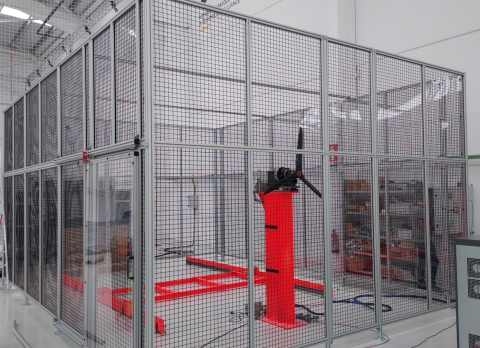
State-of-the-art infrastructure for testing and validating aerial vehicles and drones
This service makes it possible to to carry out experiments to test and validate the operating and performance parameters of electric propulsion systems (motors, drivers and propellers) of drones with a maximum take-off mass (MTOM) of less than 25 kg up to 1,000 kg and propellers with a diameter of up to 3 m.
The infrastructure is equipped with power supplies that can deliver up to 165 kW of power, making it possible to test the propulsion systems of aerial vehicles with an MTOM of up to 1,000 kg, and carry out the bidirectional testing of battery systems:
- Battery emulation: accurately replicates the electrical behaviour of different types of batteries during discharge, making it possible to carry out tests under specific, controlled operating conditions.
- Energy storage system (ESS): replicates real-world energy storage conditions, making it possible to power propulsion systems or simulate the discharge cycles of battery systems, for example.
The IAM Lab has other equipment to simulate missions before they are tested, increase the power capabilities and have more variety and range of measurements to record as a result of the tests, such as: Vehicle dynamics simulation equipment, Yokogawa WT1806 power analyser, PXIe-1082, DSpace platform, Yokogawa DLM2054 oscilloscope, other power supplies and data and signal measurement equipment.
TECNALIA develops and validates new aerial vehicle concepts, shaping the future of air travel
The Innovative Air Mobility Lab (IAM Lab) develops and validates new aircraft concepts. The infrastructure has a range of equipment and installations that provide a service to characterise the electric propulsion systems of unmanned aerial vehicles (UAVs).
There is an electric propulsion test bench for characterising aerial vehicle propulsion systems (made up of motors, drivers and propellers) and simulating ground effect at distances between 1 and 5 m. Suitable for electric propulsion systems with a thrust of up to 300 kg, torque of 300 Nm and propellers with a diameter of up to 3 m.
There is also a TURNIGY test bench for characterising and analysing the powertrains of drones with a maximum take-off mass (MTOM) of less than 25 kg, suitable for thrust values of 5 kg, propellers with diameters of 11 – 58 mm, a maximum current of 100 A, a maximum power of 6500 W and a maximum voltage of 60 V.
The infrastructure is fitted with programmable, regenerative, bidirectional DC power supplies (165 kW; 400/800 V) capable of operating as an energy storage system for testing aerial vehicle electric propulsion systems on a test bench, or as a battery emulator, making it possible to carry out the bi-directional testing of battery systems.
Makes it easier to obtain operational flight authorisations for your aerial vehicle
Our service makes it possible to test and validate electric propulsion systems and energy storage systems for unmanned aerial vehicles (UAVs) by characterising the propulsion systems of new UAV architectures of different sizes, thereby speeding up progress across all phases of propulsion system development.
These tests help to gather operational evidence that will make it easier to obtain the operational UAV flight authorisations required by aviation authorities, such as AESA in Spain.
Why choose TECNALIA to characterise propulsion systems for unmanned aerial vehicles (UAVs)?
This service provides companies and partners that require it with with pioneering, state-of-the-art, equipment for testing electric propulsion components and systems for unmanned aerial vehicles in the innovative air mobility sector. TECNALIA offers:
- A comprehensive service: from the moment you contact TECNALIA through to the delivery of results, covering every stage of the development and validation of UAV propulsion systems.
- Advice at all stages of the development of the propulsion system.
- Explanation of and advice on results: We not only provide you with the results, but also explain and break them down for you so that you can get a complete overview of the test carried out.
Who we can help
- Aeronautics and drone companies operating in the fields of urban air mobility, electric aeronautical propulsion and aerial robotics.
- Startups and companies focusing on various drone applications, such as infrastructure inspection and maintenance, logistics, firefighting, security, agriculture and other issues.